Thursday, January 22, 2009

1/22 YouTube :: Tag // vegetarian recipe

Please add updates@feedmyinbox.com to your address book to make sure you receive these messages in the future.
YouTube :: Tag // vegetarian recipe - Videos tagged with vegetarian recipe Feed My Inbox

Online Raw Food Transitioning Course
January 21, 2009 at 10:38 pm

Imagine being able to learn how to conveniently and successfully transition to a much healthier lifestyle through a Live Food diet from the comfort of your own home. Whether you want to be 100% raw or just use Live Food to achieve specific goals in your life (more energy, weight loss, immune power, etc.) this course can work for you. In this 4 week live food course you will learn all the techniques necessary to create an effective and lasting transition to a raw living food diet. Preparing delectable raw food dishes does not have to be complicated. You may even find that the hardest part of live food preparation is to not call it cooking. We will learn how to make simple inexpensive dishes that are sure to satisfy anyones taste. Not only will you learn how to make delicious raw food recipes, but you will also learn how to create original recipes of your own and practical menu plans to suit your individual lifestyle. Learning to prepare the food is only half the battle. It is essential that you understand all levels of transition from time budgeting to craving control. Each weeks in depth Live Food Lessons will cover various aspects of a Live Food Lifestyle and teach you how to organize and prepare yourself for a smooth transition to an incredibly healthy and healing diet. When you can fully grasp the concepts of a Live Food lifestyle, you will find that eating a Live Food diet is even easier than any diet you were following before. Having a reliable network of support can mean the difference between success and failure in any endeavor. With all the processed junk food reinforcement we encounter on a daily, even hourly, basis it is no wonder why so many people find it very difficult to stick to a healthier diet even when they truly want to improve themselves. In this course you will be able to meet and interact with people that share your interests and goals for greater health and abundance. By sharing your experiences, your obstacles, your setbacks, and your triumphs, you will not only create a solid network of support, but also form healthy new friendships that can last a lifetime. Everyone is coming from a different background and we all have different goals and needs. That is why everyone who enrolls will create a personal profile that will determine their individual goals and lifestyle needs. A mother of 3 will require a much different approach than a retiree, just as someone who is trying to be 100% raw will require a much different approach than someone who is just trying to incorporate more Live Food into their diet for greater health. Along with the class lesson plans, everyone will receive individual attention geared towards their own specific goals, restrictions, and desires. This is an investment in your most valuable resource. If you learn how to be a self sustainable Live Foodist you will save tens of thousands of dollars on expensive products and supplements and medical care alone. Not only will you save a tremendous amount of money but the abundance of energy, creativity, and inspiration you will experience will allow you to fulfill all of your desires and aspirations. There is nothing that compares to the joy and empowerment of optimal health and a sickness-free life of abundance.

Author: TheLiveFoodist
Keywords: raw food living food weightloss vegan classes help coaching transition healthy fitness natural healthcare
Added: January 21, 2009


Robin Gill Lacy Fox 4 Dallas
January 21, 2009 at 9:11 pm

Recipe: Vegetarian Chili Vegetarian Chili recipe from Robin Gill Lacy, Cliff Cafe Executive Chef

Author: drmarett
Keywords: 0121chef1
Added: January 21, 2009


Veg Out With Mike: Vegan-Friendly Garlic Smashed Potatoes
January 21, 2009 at 6:02 pm

Mike demonstrates how to make delicious mashed potatoes without using milk or butter. Vegan-friendly.

Author: livelife365
Keywords: vegan vegetarian how-to cooking recipe veg out livelife365 healthy nutrition
Added: January 21, 2009


Super Foods With Jules - Hemp Hummus
January 21, 2009 at 11:41 am

Join Julie Morris as she makes a Hemp Hummus: a creamy, delicious, and nutritionally-boosted version of the classic Mediterranean dip. For full printable recipe, eco-saavy articles, and more information on the art of living well, visit www.JulieMorris.net

Author: superfoodswithjules
Keywords: Cooking Easy Economical Fats Food Healthy Hemp Mediterranian Nutriti Omega Raw Recipe Show Vegan Vegetarian
Added: January 21, 2009


Orange Fennel Soup
January 21, 2009 at 10:32 am

This is delish vegetable soup with a tasty zing of orange flavor.

Author: TheGreenGirlsTV
Keywords: Carrot Fennel Orange Soup thegreengirls.com cooking show recipe food how to diy instructional detox vegetarian vegan
Added: January 21, 2009


This email was sent to diasomie.vegetarian@blogger.com .
Don't want to receive this feed any longer? Unsubscribe here.

Wednesday, January 21, 2009

1/21 YouTube :: Tag // vegetarian recipe

Please add updates@feedmyinbox.com to your address book to make sure you receive these messages in the future.
YouTube :: Tag // vegetarian recipe - Videos tagged with vegetarian recipe Feed My Inbox

A Cure for Vegetarianism using Calvin Harris Fly Eye Spectacles!
January 20, 2009 at 5:38 pm

With a brilliant soundtrack, this is the story of Henrietta, a bored Vegetarian. She remembers Calvin Harris' age old recipe for Fly Eye specs, and wonders if the method could be adapted to help her cause. Using some of the staple ingredients: a shoe, flowers and crispbreads, she embarks on a journey to discover Meat.

Author: henrietta99jones
Keywords: Calvin Harris Disco Merrymaking Industry Colours Yellow Girls Fly Eyes Vegetarian Vegetarianism Henrietta Jones
Added: January 20, 2009


This email was sent to diasomie.vegetarian@blogger.com .
Don't want to receive this feed any longer? Unsubscribe here.

Saturday, January 17, 2009

Reasons to go Vegetarian

Reasons to go Vegetarian

REASONS TO GO VEGETARIAN
Health
Meat/Dairy centered diets are linked to many types of cancer, as well as heart ailments, diabetes, obesity, gallbladder disease, hypertension, and more deadly diseases and disorders.
The National Cancer Research Institute found that women who eat meat on a daily basis are almost 4 times more likely to get breast cancer than those women who eat little or no meat.
Meat contains approximately 14 times more pesticides than plant foods; dairy products contain 5-1/2 times more pesticides than plant foods.
15 million pounds of antibiotics are used in animal production every year- These drugs end up in your milk and meat.
95-99 percent of toxic chemical residues in the American diet come from animal sources.
By reducing your consumption of meat,, dairy products and eggs by 50%, you reduce your risk of a heart attack by 45%. By following a pure vegetarian diet (no animal products at all) you reduce your risk by 90%.
Meat and dairy products raise the acid level in human blood, causing calcium to be excreted from the bones to restore the body’s natural pH balance. This calcium depletion results in osteoporosis. Contrary to the common belief that dairy products are necessary to prevent osteoporosis, dairy consumption actually increases the likeliness of this crippling disease.
About 30% of all pork products are contaminated with toxoplasmosis, a disease which is caused by parasites. It can be passed on to consumers.
The vegetarian diet is more likely to meet the government recommendations for fat, carbohydrate, and protein than a nonvegetarian diet. The government as well as many other organizations tell us to reduce our fat intake (especially saturated fat) and also to eat more grains, fruits, and vegetables. This is easy for a vegetarian!
On a meatless diet, you are less likely to get a bacterial infection such as E. coli, Camphylobacter, and Salmonella.
Animal Welfare
Animals are able to feel pain just as we can!
About 7 billion farm animals die or are slaughtered each year in the U.S. for the production of flesh food.
There are virtually no laws against cruelty to animals raised for food in the U.S. The Animal Welfare Act, which governs the humane treatment of animals, excludes animals intended for food consumption.
Up to five hens are crowded into a cage with floor space hardly larger than a record-cover, for their entire life-time.
Many factory-farmed animals never see a blade of grass in their lifetime.
In the egg industry, male chicks are considered useless so are often thrown into a grinding machine- ALIVE!
Animals raised for food production are nearly always deprived of natural sexual, social, hygienic, and parental behaviors.
Reason for veal’s light color and tender texture: Veal calves are force-fed an iron-deficient, anemia-producing diet devoid of solid foods.
Bulls raised for meat-production are routinely castrated without any type of anesthesia or pain-killers.
Many animals are transported to slaughter without food and water for a long time! Millions die on the way to slaughter.
The slaughtering process is inhumane. When the animals are stunned before they are slaughtered, it is not always reliable and the animals are in pain as they move towards their death.
Environmental Problems
Livestock production is a major cause of desertification (where the land dries out and loses its precious topsoil so vegetation is unable to grow on it anymore) as well as deforestation (loss of trees).
Two hundred years ago American cropland had topsoil that averaged 21 inches in depth. Today, only about 6 inches remain. Every year in the U.S. an area the size of Connecticut is lost to topsoil erosion- 85% of erosion is associated with livestock production.
Spinach grown on an acre of land can yield 26 times more protein than beef produced on the same acre.
Number of pure vegetarians who can be fed on the amount of land needed to feed one person consuming a meat-based diet: 20
Some beef comes from cattle raised on land that was formerly rainforest. This land is not good for grazing and it lasts only for a few years, after which more rainforest must be destroyed to raise the cattle on.
For each quarter-pound fast food hamburger sold that came from cattle raised on former rainforest land, 55 square feet of rainforest was destroyed.
A lot more water is required in animal agriculture than in plant agriculture. It takes only about 25 gallons of water to produce a pound of wheat and around 390 gallons to produce just one pound of beef. In fact, It takes less water to produce the food that a pure vegetarian needs for one year than to produce the food that a meat eater needs for a month.
Animal production requires a lot of fossil fuels. Fuels are needed to transport animal feed, to heat their housing, and to take the animals to slaughter, meat packing plants, and grocery stores. The burning of these fuels, as well as methane produced by the animals, is one cause of global warming.
Pesticides, herbicides, and fertlizers used in the production of animals’ feed pollute land and water.
Many plants and animals become extinct due to the destruction of land.
World Problems
60 million people will starve to death this year - 60 million people could be adequately fed by the grain saved if Americans reduced their intake of meat by 10 percent.

Friday, January 16, 2009

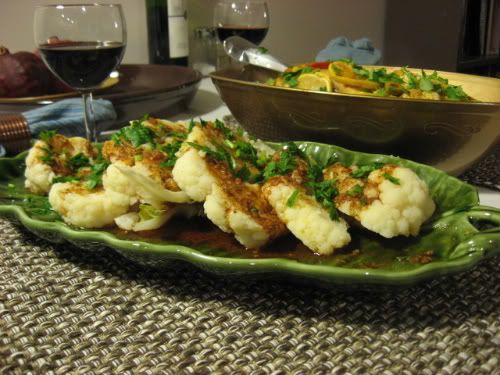
Moroccan Cauliflower Recipe + A "Specific Carbohydrate Diet" Cookbook Review

We decided to spend a relaxed New Year's Eve at home, with a movie, a bottle of wine, and a home-cooked Moroccan feast for two. What better opportunity to crack open some cookbooks I haven't yet used? Seeing as my partner has re-started the South Beach Diet and I'm doing my own low-glycemic food thang, the first book I went to was Eat Well Feel Well by Kendall Conrad. This is a book of recipes that comply with the Specific Carbohydrate Diet.

One of the perks of being a food blogger is having publishers send you new cookbooks to look at. Unfortunately I am way behind on cookbook reviews, so many months after receiving this book from Clarkson Potter Publishers, I'm finally getting around to using it, perusing it, and sharing my feedback here. I was won over by the beautiful color photographs in the center of the book. I must admit I have a serious aversion to cookbooks that don't have full-color photos, so the photo section of this book was a real plus. The Specific Carbohydrate Diet is used to treat sensitive tummies as well as guts that have been damaged by Crohn's disease, ulcerative colitis, celiac disease, irritable bowel syndrome, diverticulities, etc. Celiacs and gluten intolerant folks who eat a strictly gluten-free diet usually find that their guts eventually heal and are generally able to tolerate any non-gluten foods after the healing period is over. However, many of us have multiple food allergies or other digestive disorders. Others find that they continue to be sensitive to a variety of foods and have trouble with digestion long after they are gluten-free, due to damage to their digestive tract. A small number of people find that they simply cannot digest grains at all, and that non-gluten grains make them almost as ill as gluten-containing grains. This cookbook is based on the diet described in the book Breaking the Vicious Cycle: Intestinal Healing Through Diet by Elaine Gottschall, which is the bible of the Specific Carbohydrate Diet (SCD). The diet eliminates "virtually all starch and complex sugars" and features a balance of "smart carbohydrates, good proteins and fats, and essential vitamins and minerals." It is grain-free. No unfermented / un-aged dairy products are allowed so the diet is lighter on dairy than most. This way of eating has helped many people recover from life-threatening digestive disorders.

The difficulty of digesting grains has been explored in other books over the years, such as Against the Grain by Melissa Smith. I don't personally feel a need to eat this way, but many if not most of these recipes are also low-glycemic and low-carbohydrate and therefore fit well into my household's meal plans. Best of all they don't reflect deprivation, but rather an enjoyment of the plentiful healthy gut-friendly foods available at the farmer's market or grocery store. There are grain-free recipes for everything from grain-free Cashew Butter Tortillas to Peach Pocket Pies, and from Shepherd's Pie with Mashed Cauliflower to Tom Yum Kai with Coconut Milk & Lemongrass Infusion.

Tonight I tried my first recipe from the book, which was Moroccan Cauliflower. While it was the photo that first caught my eye, I was also intrigued by the unusual (or at least new to me) method used for cooking cauliflower. Although my favorite method for cooking cauliflower is roasting it, I think this will be my new cauliflower technique for when times is short or I'm trying to reduce the fat in a dish. By steaming the entire head of cauliflower without cutting it first, it avoids all the wasted little cauliflower bits that litter the cutting board when you try to cut a raw cauliflower into florets, because it's far easier and neater to slice a whole head of cauliflower when it's cooked. The presentation of this dish is lovely, and it might even convince one of those notorious cauliflower haters to reconsider.

Here is my adaptation of the recipe from Eat Well Feel Well. I hope you enjoy it, and have a fabulous, healthy and safe New Year!

Thursday, January 15, 2009

Vegetarian Diet For Life:

Vegetarian Diet For Life:
This is a balanced vegetarian diet plan that you can follow for LIFE. It provides a choice of easy breakfasts, lunches, easy main meals and desserts - plus snacks. In addition, it contains a suggested 14-day menu to get you started. It also includes simple advice on how to cook grains, legumes, rice, pasta, pizza, potatoes and tortillas.
The meals in the Vegetarian Diet for Life provide about 1250 calories per day. You may increase this calorie intake to 2000+ calories by adding extra snacks from a wide snack-list. The diet contains the widest possible choice of foods with SIMPLE recipes. For example, in the main meal section you have a choice of over 100 main dishes with foods like:
more here on the blog surce: vegetarian diet and cookbook
Bread, Potatoes, Rice, Pasta, (Tortillas, Tacos) Cereal, Fruit, Fruit Juices, Smoothies, Vegetables, Beans, Legumes, Low Fat Dairy Products, Low Fat Ice-Cream, Mousses, Yogurt, Frozen Yogurt and lots more!
The diet is low in fat-content and moderate in protein. Designed to help you to normalize your weight, it offers slow, steady weight reduction rather than quick weight-loss.
As well as a HUGE range of easy recipes, it includes information on fat, calories and cholesterol, plus GUIDELINES for SENSIBLE EATING FOR LIFE.
This is an Ideal Weight Loss Plan For…
This diet is perfect for any vegetarian who wants to learn about healthy vegetarian eating, and who needs an easy weight loss plan to normalize their weight in a gradual way.